 Maplefinance
 withdrawals - pool liquidity, redemption value, and exit timing
Maplefinance withdrawals return lending capital when the relevant pool has liquidity and the applicable redemption process completes. For syrupUSDC and syrupUSDT, requests join a first-in, first-out queue and continue earning interest until processing. The withdrawal guide reports most requests finishing in under 24 hours, with delays up to 30 days. Syrup’s risk disclosures specify no guaranteed maximum. The final amount reflects the exit exchange rate when shares redeem. Institutional pools, Cash Management positions, and crosschain routes have additional terms that affect an exit.
Updated onLiquid assets available for the requested exit
When capital remains in outstanding loans, the pool’s total value can exceed the liquid assets available to service withdrawals. Pool accounting includes cash alongside assets managed through lending and other strategies. Loan principal and accrued interest contribute to that value, even before they return as spendable assets. Borrower repayments can replenish the funds that the pool can distribute. Collateral coverage describes the backing for loans and answers a different question from immediate withdrawal capacity.
Share redemption and the price at processing
An automatic withdrawal request commits pool shares to an exit whose asset value depends on the exchange rate at processing. The withdrawal manager holds the requested shares while they wait. In the ordinary automatic queue, processing exchanges those shares for the pool’s underlying asset and sends it to the owner’s wallet. The standard Syrup flow does not require a separate claim transaction afterward. Continued interest accrual during the wait affects the lending position’s value; it does not establish a fixed payout at submission.
Maple’s exit conversion accounts for unrealized losses when calculating the assets attributable to a given number of pool shares. The exit rate equals total pool assets minus unrealized losses, divided by the outstanding share supply. A general portfolio valuation can differ from the amount available through redemption during an impairment. The share amount, exit rate, and available liquidity each answer a separate part of the withdrawal question.
Normal processing times and separate banking schedules
Syrup and secured institutional lending
For syrupUSDC and syrupUSDT, most withdrawals finish in under 24 hours, with possible delays extending to 30 days. Syrup’s FAQ describes a 30-day maximum for syrupUSDC, syrupUSDT, and syrupUSDG, but its risk disclosures state there is no guaranteed maximum withdrawal period. Actual processing requires available funds. Immediate liquidity can support a prompt exit, but the elapsed time also includes processing of requests ahead in the queue. A typical turnaround does not reserve cash for a particular deadline.
Maple Institutional - Secured Lending states a maximum time to liquidity of 30 days. Its queue delivers funds directly to the lender’s wallet under that pool’s own contractual terms.
Cash Management banking days
A position governed by Maple’s Cash Management Pool terms follows a separate banking-day schedule. Its withdrawal rules require 24 hours’ notice and a request no later than 13:59 Eastern Time for next-business-day availability. Servicing follows chronological order on U.S. banking days, excluding weekends and bank holidays. Available liquidity can support non-banking-day processing; otherwise, the terms place servicing at bank reopening. Intra-day requests on banking days can finish in as little as three hours. This faster case does not replace the notice cutoff for planned next-day availability. Normal market functioning and proper USDC functioning remain conditions of those terms.
Partial payouts and changes to unprocessed shares
When the queue reaches a request that available liquidity cannot fully cover, the withdrawal manager can redeem only part of it. Earlier requests consume liquidity before later requests. The authorized operator sets the number of shares to process in each batch.
Partial fulfillment
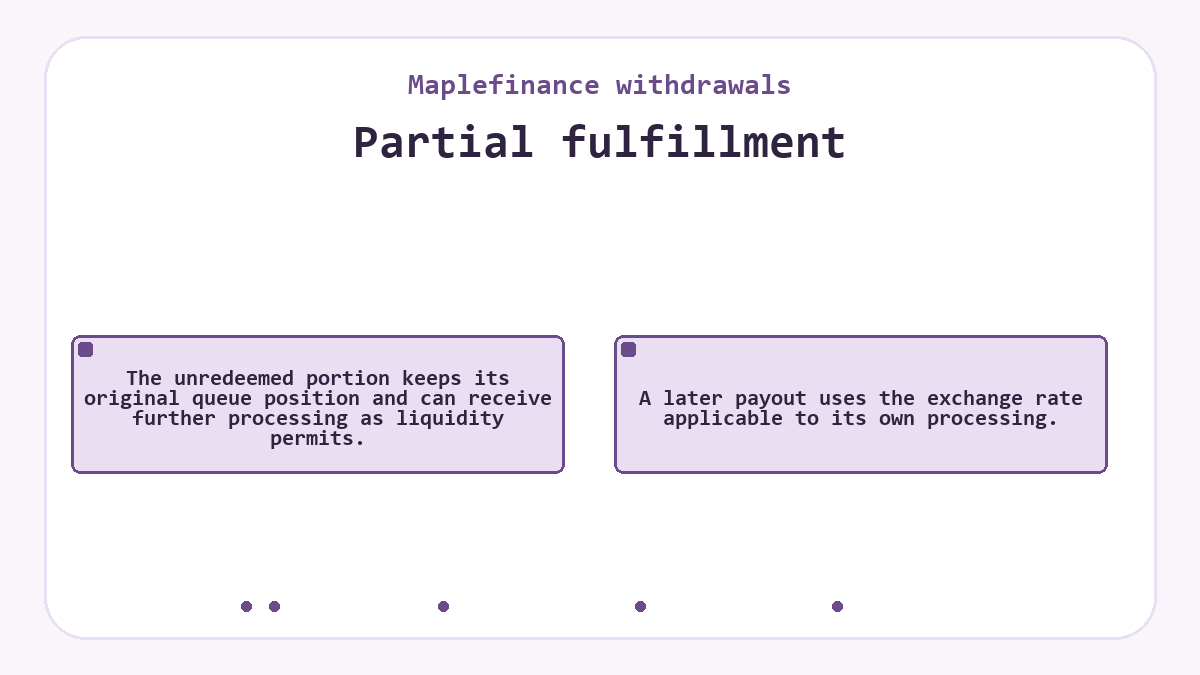
The unredeemed portion keeps its original queue position and can receive further processing as liquidity permits. A later payout uses the exchange rate applicable to its own processing.
Returning unprocessed shares
Reducing a request
Before processing, the request owner can reduce the share amount committed to the queue. The manager returns the removed shares to the owner, while the smaller request retains its place. This adjustment releases part of the lending position from the pending exit without converting those returned shares into the underlying asset.
Cancelling the remainder
Cancelling the entire unprocessed remainder returns its shares and removes that request. Cancellation does not reverse the asset conversion for shares already redeemed.
Configured manual handling
Automatic handling is the standard user flow. The queue contract also supports an administrator-enabled manual mode, intended for internal compatibility, in which redemption follows queue processing. That configuration requires a later redeem call.
A proceeds threshold under an assumed exit rate
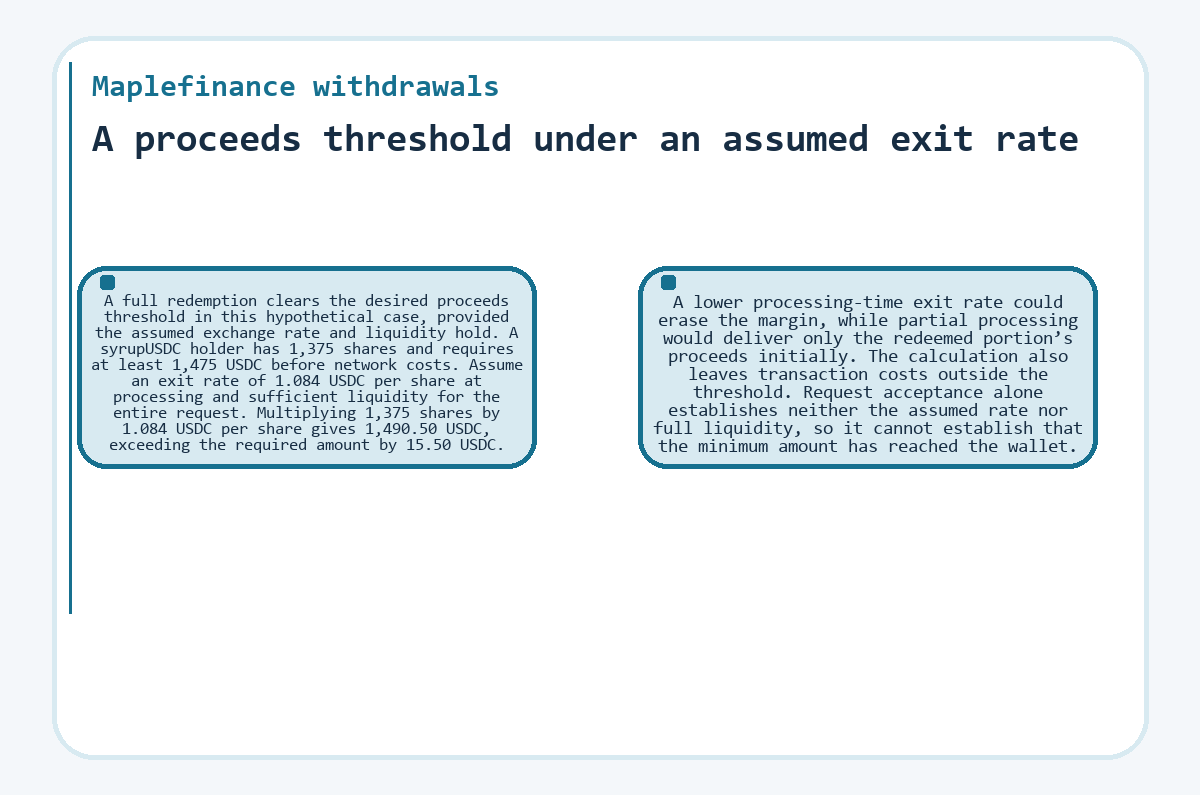
A full redemption clears the desired proceeds threshold in this hypothetical case, provided the assumed exchange rate and liquidity hold. A syrupUSDC holder has 1,375 shares and requires at least 1,475 USDC before network costs. Assume an exit rate of 1.084 USDC per share at processing and sufficient liquidity for the entire request.
Multiplying 1,375 shares by 1.084 USDC per share gives 1,490.50 USDC, exceeding the required amount by 15.50 USDC.
A lower processing-time exit rate could erase the margin, while partial processing would deliver only the redeemed portion’s proceeds initially. The calculation also leaves transaction costs outside the threshold. Request acceptance alone establishes neither the assumed rate nor full liquidity, so it cannot establish that the minimum amount has reached the wallet.
Impairment losses at the point of exit
An active impairment can reduce redemption proceeds even when the pool has enough cash to process a withdrawal. Maple’s impairment accounting can recognize concerns about loan repayment or losses in a strategy. This reduces the exit valuation to recognize potential losses across existing lenders. Overcollateralized lending still involves collateral-price changes and borrower repayment risk.
Redeeming Syrup shares during an active impairment forfeits participation in subsequent recoveries for the redeemed portion. The withdrawal realizes the reduction applicable at exit. Future recoveries accrue proportionally to lenders who remained in the pool; deposits made during the impairment do not gain a claim to recoveries forfeited by withdrawing lenders. Staying exposed preserves that participation while also preserving exposure to the unresolved loan. Neither liquidity nor queue position establishes the eventual recovery amount.
Selling syrupUSDC into market liquidity
A syrupUSDC market swap offers an alternative exit when a holder accepts the price available from trading liquidity. Supported swap venues include Uniswap and Balancer. A swap draws its output from market trading liquidity; a pool redemption draws on the lending pool’s available assets. These routes can therefore produce different amounts and involve different timing constraints.
A swap quote reflects market liquidity, fees, and slippage rather than a promise to redeem at the pool’s accounting value. Thin trading liquidity or price changes can lower sale proceeds relative to a pool valuation snapshot. When a Uniswap exact-input integration applies a minimum-output setting, the transaction reverts if execution cannot satisfy it. Once the holder sells the shares, those sold shares no longer earn lending yield for that holder. This documented alternative concerns syrupUSDC and does not establish an equivalent market for every Maple pool token.
Crosschain exits and return delivery
On a supported crosschain route, redemption includes both the Maple pool process and delivery of the resulting tokens back to the origin chain. The Maple CCIP Receiver accepts the configured pool’s share token and records a redemption request. An authorized redemption executor later redeems shares and arranges the return transfer through Chainlink’s Cross-Chain Interoperability Protocol, or CCIP.
The Maple CCIP Receiver’s redemption request identifier records a queued request rather than completed delivery of underlying assets. Receiving funds on the origin chain also requires the return message to complete. The receiver converts any configured redemption fee from assets to shares and deducts it before queuing the request. Submitted shares must exceed the converted fee; amounts below it fail receiver processing. Return delivery also requires funding for CCIP messaging. Its receiver must support the selected pool and chain, and redemptions must be enabled. Token availability on a network alone does not establish that its interface supports native redemption there.
Asset and permission boundaries
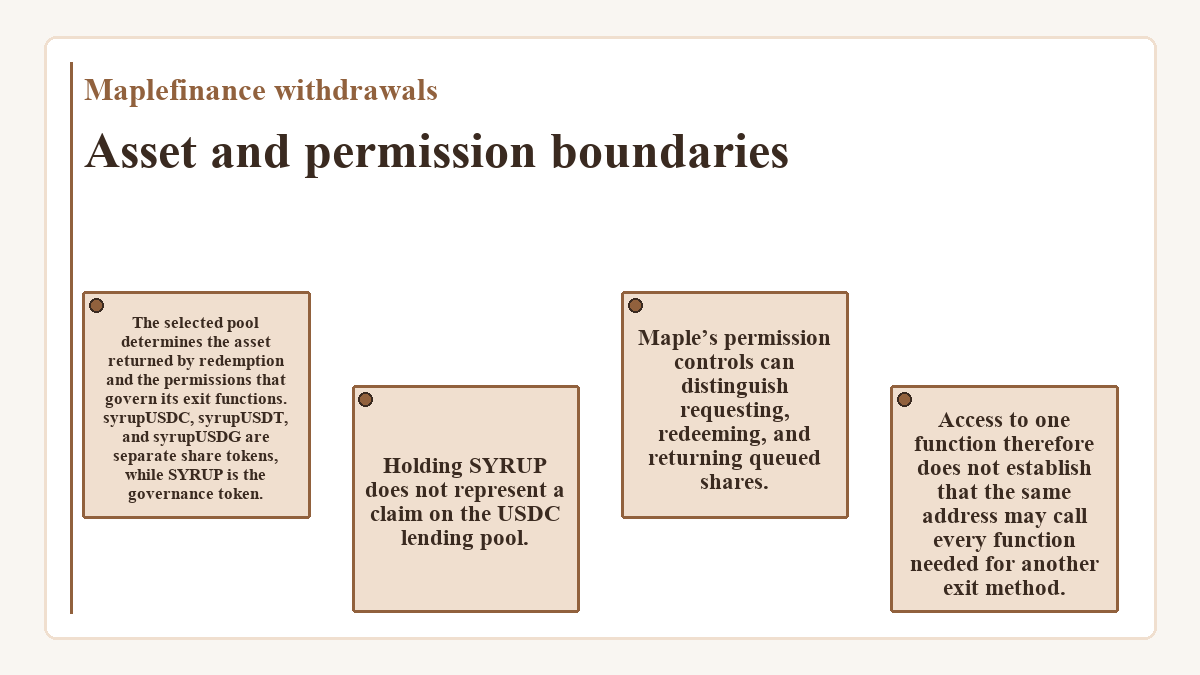
The selected pool determines the asset returned by redemption and the permissions that govern its exit functions. syrupUSDC, syrupUSDT, and syrupUSDG are separate share tokens, while SYRUP is the governance token. Holding SYRUP does not represent a claim on the USDC lending pool. Maple’s permission controls can distinguish requesting, redeeming, and returning queued shares. Access to one function therefore does not establish that the same address may call every function needed for another exit method.
Helpful answers
Why does maxRedeem return zero despite a visible pool share balance?
maxRedeem can return zero when the pool’s withdrawal mechanism does not currently permit that address to redeem shares. The readout concerns currently redeemable shares, while a wallet balance describes shares held. Pending withdrawal conditions can therefore coexist with a positive holding. A zero redemption readout alone does not establish that the entire lending position has lost its value.
Does a higher gas fee advance an accepted withdrawal request?
A higher Ethereum gas fee does not advance a request that has already joined Maple’s first-in, first-out withdrawal queue. Network priority fees affect transaction inclusion, while the withdrawal manager processes accepted requests in queue order. Paying more for transaction execution also does not supply the lending pool with the assets needed to fund your redemption.
Are management fees charged again on principal when I withdraw?
Maple’s management fees apply to gross borrower interest when loan payments reach the pool, rather than to withdrawal principal. The remaining interest accrues to liquidity providers. An exit can separately involve network fees, swap costs, or configured crosschain redemption charges. Those costs concern the selected exit route and should not be treated as another deduction of the interest-based management fee from principal.
Can I transfer institutional pool shares to another wallet before requesting a withdrawal?
Transfers of permissioned institutional pool shares require the receiving wallet to be on Maple’s Global Allowlist. An eligible transfer changes who holds the lending position; it does not itself convert the shares into cash. Shares already held by the withdrawal manager remain committed to their request until redemption or an applicable reduction or cancellation returns them.
Could a protocol pause block a withdrawal from a liquid pool?
Maple’s pause controls can block the contract function required for an exit even when the pool has liquidity. Controls can apply globally or to a particular contract, with selected functions available through the recovery configuration. Cash availability therefore cannot establish that every withdrawal-related function is callable. A pause condition is distinct from insufficient pool liquidity.
How does failed crosschain message recovery differ from cancelling a queued redemption?
Failed-message recovery addresses a stored CCIP processing failure, while cancellation addresses an accepted pool redemption request. Anyone can retry or recover a stored message while it remains in the FAILED state. Retry uses the receiver’s native-token balance for messaging fees. Recovery attempts the original processing first; if that fails, it returns tokens to the original sender through CCIP, provided the caller funds the return fees. An authorized redemption executor can remove an accepted crosschain redemption and return its queued shares through CCIP, funding the return-message fees.
Will withdrawing syrupUSDC release historical Drips rewards?
Withdrawing syrupUSDC does not release historical Drips rewards. The Drips program ended, and its final claim window for Q4 2025 rewards ran from January 18 to February 18, 2026. Unclaimed rewards after that deadline cannot be claimed through a lending withdrawal. Lending proceeds, historical reward claims, and any separately offered partner incentives follow different rules.